Only the original release of NVThermIP is validated
The Legacy NVThermIP in NVIPM is not NVThermIP
The current Future Command modelers have never explained why the Targeting Task Performance (TTP) metric accepted by the Army to replace the Johnson Criteria has been dropped. Without explanation, without any supporting experiment data, without citing any theory, and without being open and transparent about their actions, the current Army modelers have dropped the validated TTP and substituted the different metric in NVIPM.
We know from participants evaluating the NVIPM metric that validation failed. True, the Future Command refuses to publish those results, so “proof” does not exist. However, the fact that no data supporting NVIPM has ever been published is a certain indicator of NVIPM failure.
Now, journal articles are appearing (8-11) claiming that the validation of the original TTP, the validated TTP, actually supports the failed NVIPM. How is that possible? First, drop the validated metric for no stated reason. Then try and validate the new metric and fail at every step. Now, claim the validation of the TTP actually validates NVIPM and get journal editors and reviewers to go along with that twisted logic.
Albert Einstein once said: “Explanations should be as simple as possible, but no simpler.” We will try to explain what the Future Command has done.
Discussion outline:
- TTP metric fundamentals and validation.
- What the Future Command modelers changed.
- Effect of the change on model predictions
- Validation data, or the lack thereof, for NVIPM.
The validated logic of the original TTP metric
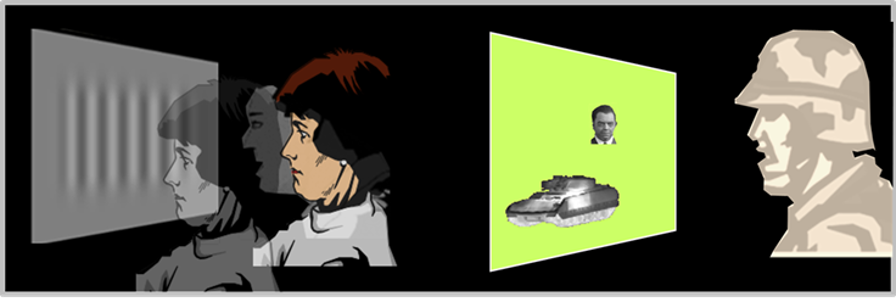
The original TTP is a frequency domain model that compares eye threshold at each frequency to the spatial frequency content of the target at each spatial frequency. See Reference 7. Eye threshold is measured by vision scientists and called the Contrast Threshold Function (CTF). A single frequency is a sine wave with infinite periods, but vision scientists have discovered that between seven and eleven sine wave periods are enough to get an accurate threshold measurement.
Also, most researchers measuring CTF ensure that the eye is adapted to the display luminance, so even given that eleven sine wave periods are presented, the display luminance is made the same as the sine wave pattern over a large area.
The CTF of several people with good eyesight are measured one at a time at left below and the average CTF used to represent the average soldier at right. That is, we represent the CTF of the soldier at right with the measured sine wave thresholds. We have a typical observer with good eyesight.
The soldier’s eyes adapt to the display even though he is fixating the tank. Luminance adaptation does not occur only on a fixated object. The eye adapts to the display luminance, and the display luminance establishes the threshold contrast values at each spatial frequency.
The tank is represented by the Fourier Transform of the tank or a set of vehicles is represented by a Normal Distribution CTGT. TTP compares tank frequency content to frequency threshold of the eye. CTGT is target contrast, CTFsys is CTF adjusted for imager noise and blur, ε is spatial frequency, low and cut are frequencies where CTGT is less than CTFsys.
Note, after initially using what is referred to as a Target Transform Probability Function (TTPGF) that curve fits PID predictions to metric values, we finally realized that the error function (erf) relates PID to metric value if the IQM is actually valid.
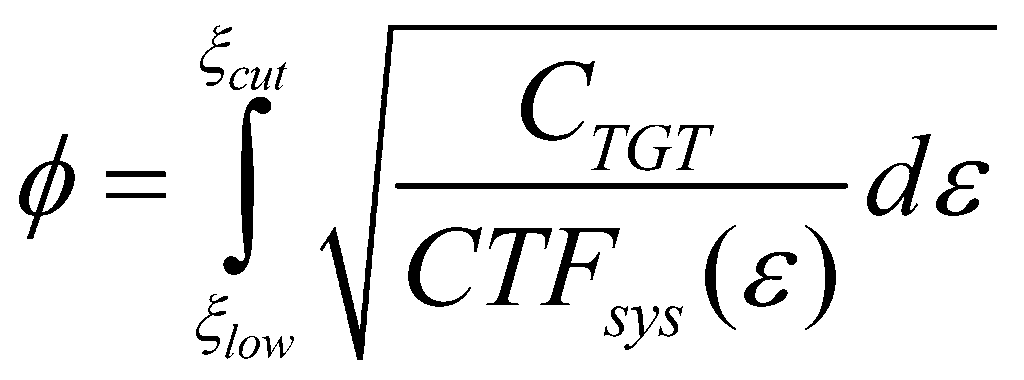
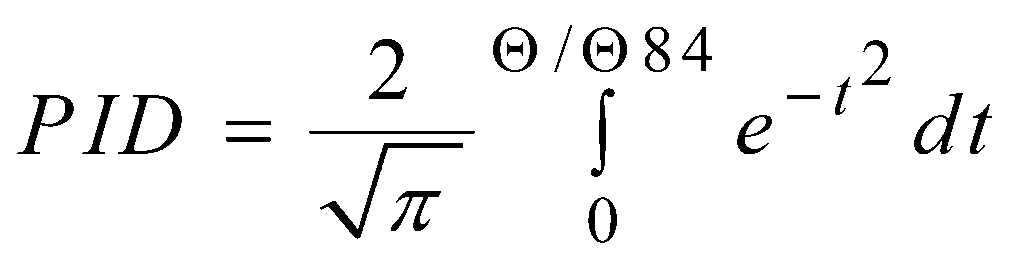
The importance of CTFsys is obvious, as is the importance of getting the mathematical description of CTGT right. Since the TTP metric uses the standard definition of CTF, the literature contains experiment data taken by independent researchers of the effect of noise on CTF of the naked eye. We compared our CTFsys model to the data of independent researchers, and some of the results are shown here. See [7] for details and additional examples.
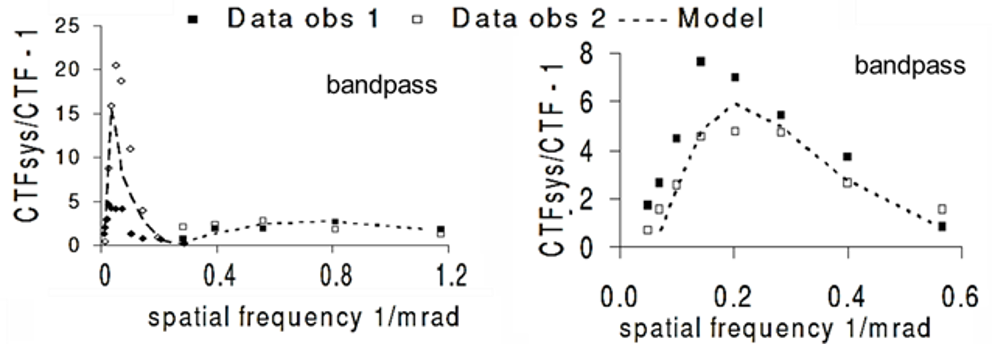
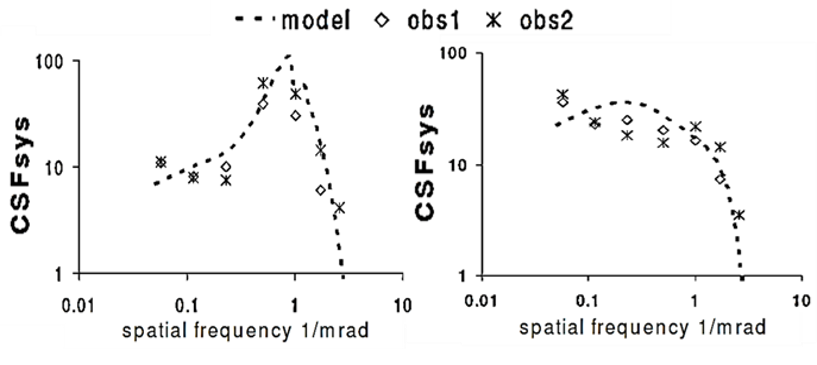
Note that the current Army modelers state that the TTP noise model is incorrect because it does not predict NVIPM CTF behavior.. Of course not; NVIPM uses a non-standard definition of CTF. We have validated our model to standard CTF data. The statements by current Army modelers that our noise model is incorrect are baseless and outlandish.
We get naked eye CTF using Barten’s numerical CTF algorithm [13]. Barten’s algorithm is used because an independent researcher[14] says it is accurate and easy to use, as long as the display size and luminance are entered correctly. Our selection of Barten’s CTF numerical generator was because it provides CTF of young people with good eyesight and is easy to use. Our selection of CTF algorithm had nothing whatsoever to do with Barten’s IQM work. Any suggestion otherwise is an attempt to distract and obscure the fact that NVIPM has no foundation in experiment or theory. None.